Minimal Zine Poster
One small visual relation, given room on the page
Make quiet posters from open paper, a small visual metaphor and one vivid accent. It can also return a four-paragraph prompt or reusable rules derived from references.
 Open original
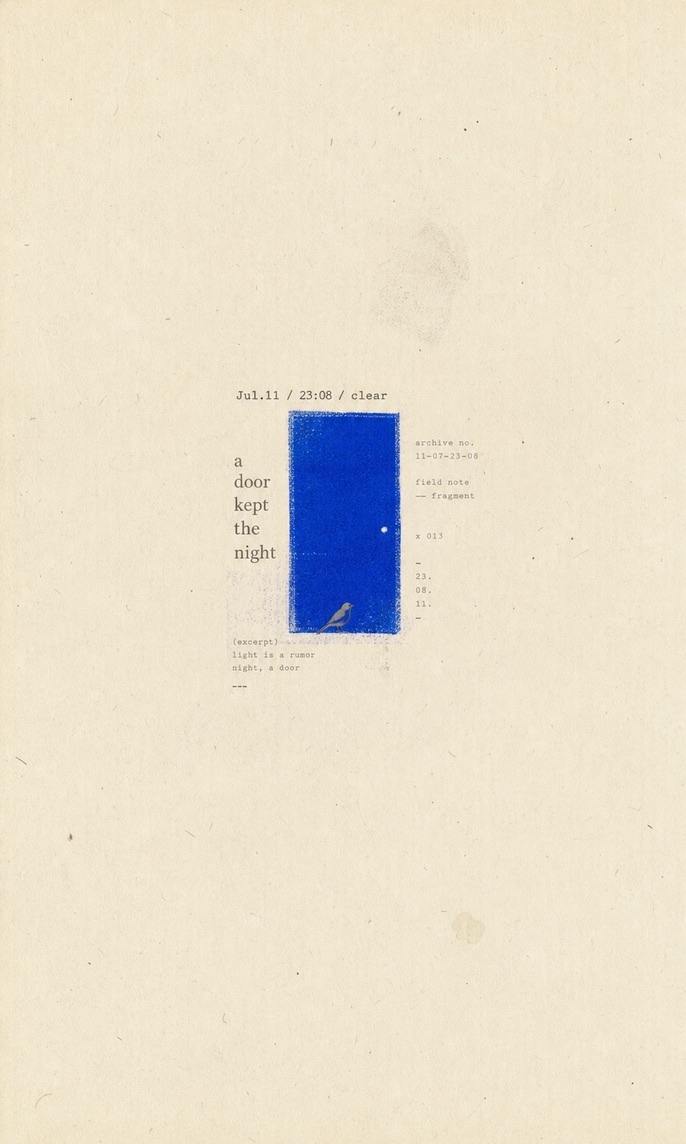
A narrow blue rectangle carries the main color, with short text around it and a broad warm-paper field isolating the event.
Author example sourceThese are three of the six examples credited to the repository author, taken from the fixed commit. Each original JPEG is 686 × 1144. They are not site-generated images or photo-preservation tests, and do not establish that every numerical style target is met.
Runtime
- Codex: invoke $gc-minimal-zine-poster-v0-3
- Other compatible hosts: confirm skill loading, image input and generation separately
- GitHub stars
- 7,434
- Version
- 0.3.1
- Checked
- Categories
- Design & Video
Settle one theme before spending an image call
Start with the prompt-only task below and check whether it turns the theme into a concrete relation with a physical carrier for the color. Generate a single poster once the tools are available. For photos and references, decide each image's role first.
Pick a task and get started
Install the complete directory in a terminal, then return to Codex and confirm the skill appears. Restart Codex if necessary. Invoke the name with its v0-3 suffix. The first task produces a text plan; the second and third also require image generation and inspection.
Adapted from the author's unsent-letter evaluation as a prompt-only first task. Use it to review the concept and composition, or when the host has no image tool.
Install the verified v0.3.1 tag
Run this in a terminal, not as a chat command. It follows the author's clone route with --branch v0.3.1 added to pin the verified tag. Use it only for a new installation where the target directory does not exist.
Read the author’s setup guidegit clone --branch v0.3.1 \ https://github.com/LiamGvchi/gc-minimal-zine-poster.git \ ~/.codex/skills/gc-minimal-zine-poster-v0-3Keep the directory and callable name aligned
The displayed version is 0.3.1, while the frontmatter and callable name remain gc-minimal-zine-poster-v0-3. This command is for a new installation where that directory does not exist. Inspect existing files or local changes and follow the author's upgrade guidance instead of overwriting them. Keep a v0-1 installation in its original directory and install this version separately under v0-3.
Read installation and upgrade guidanceGive your AI this first task
These tasks are editorial examples, not image-model runs performed here. The first supplies its own theme; attach real article or image inputs for the others. Each task states whether generation is requested. Area percentages are design targets, not measured output.
Use $gc-minimal-zine-poster-v0-3 to write the final image prompt for “a letter still waiting to be sent.” This is Prompt-only mode; do not generate an image. The only poster phrase is “Tomorrow, perhaps.” Read the installed style, prompt-compiler and variation references. Reduce the theme to one visible relation. Use the default vertical 3:5 canvas, warm paper, generous open space and a small subject, with a layout other than the habitual centered composition. Make tomato red the sole main accent and identify the physical object or paper fragment carrying it. Do not leave the focal point as abstract compositional language. The theme is not maritime, so introduce no unrelated nautical symbol or generic pictogram. Follow references/prompt-compiler.md with four compact paragraphs: canvas, paper and subject geometry; metaphor and visible carrier; short text, exact hue, target color area and print treatment; then flat-scan mood and relevant avoids. Ratios are design targets, not measurements of a generated result. List the Recipe separately: layout, metaphor, focal-element form, typography, main hue and carrier, texture, decoration and mood. Add relevant negative constraints. Check that there is one central relation, the supplied phrase is unchanged, and low-saturation directions for the paper do not wash out the main color. Do not claim to have generated or inspected a poster.
Check what you receive
- A four-paragraph prompt for a compatible image tool, with concrete placement, size, materials, short text and color directions.
- A separate Recipe and relevant avoid list that can guide a later theme or layout variation.
- Text only: no image file and no claim of visual inspection.
More about this skill
Minimal Zine Poster turns a theme, article or photograph into a quiet editorial poster. Most of the image remains open paper, carrying one small visual event and a clearly saturated accent. It suits personal artwork, article covers and independent publications, with text used as a note or fragment. Dense event information and commercial headline layouts are outside its default direction.
This is one Codex skill, not a layout application or an image model. The package consists mainly of a workflow, five design references, interface metadata and author examples. It includes no generation scripts, font package or API keys. It asks the assistant to read the content, choose a metaphor and variation recipe, then compile the decisions into four prompt paragraphs. The host must provide tools to generate and inspect the image.
A request to make a poster defaults to generation and returns the image, prompt actually used, Recipe and a short explanation. Explicit prompt-only requests return text. Reference analysis first inspects the supplied images and separates shared rules, safe variations and sample-specific material that should not be copied. Photo input is a generation subflow: each image must be assigned an edit-target, style-reference or supporting-insert role.
Identifiable people, pets and products default to High preservation constraints, not a fidelity guarantee. The actual source image must reach the image tool, and visible details must be compared afterward. Preferring a photo fragment over a redraw is a production direction; the model can still alter a face, clothing or structure, and remaining drift must be disclosed.
Sources and verification
Sources checked
The current README, SKILL and all five reference documents were read in full, and three original author images were visually inspected. No installation or image-generation tool was run here.